
All Assaults stem from the same section in the Criminal Code of Canada. As of 2015, the section in the Criminal Code of Canada pertaining to Assault is section 265 and is defined as:
265. (1) A person commits an assault when
(a) without the consent of another person, he applies force intentionally to that other person, directly or indirectly;
(b) he attempts or threatens, by an act or a gesture, to apply force to another person, if he has, or causes that other person to believe on reasonable grounds that he has, present ability to effect his purpose; or
(c) while openly wearing or carrying a weapon or an imitation thereof, he accosts or impedes another person or begs.
http://laws-lois.justice.gc.ca/eng/acts/C-46/section-265.html
Assault Causing Bodily Harm is an Assault that results in “Bodily Harm”. The Crown Attorney must prove beyond a reasonable doubt that both an Assault and Bodily Harm occurred.
The elements of Assault are noted above (Section 265). “Bodily Harm” is defined in Section 2 of the Criminal Code of Canada as “any hurt or injury to a person that interferes with the health or comfort of the person and that is more than merely transient or trifling in nature”
http://laws-lois.justice.gc.ca/eng/acts/C-46/page-1.html#docCont
Assault Causing Bodily Harm is a Hybrid Offence. Meaning that where a Defendant is charged with an Assault Causing Bodily Harm, the Crown Attorney can elect to proceed either Summarily or Indictable. The Crown Attorney makes the election, between Summarily and Indictable, early in the proceeding; if the Crown Attorney does not elect, then they are presumed to have elected Indictable. Depending on the election, the accused may face significant incarceration if found guilty.
267. Every one who, in committing an assault,
a) carries, uses or threatens to use a weapon or an imitation thereof, or
b) causes bodily harm to the complainant,
is guilty of an indictable offence and liable to imprisonment for a term not exceeding ten years or an offence punishable on summary conviction and liable to imprisonment for a term not exceeding eighteen months.
http://laws-lois.justice.gc.ca/eng/acts/C-46/page-133.html#docCont
I have included a chart to facilitate the understanding of the possible sentencing available if one is found guilty of Assault Causing Bodily Harm.
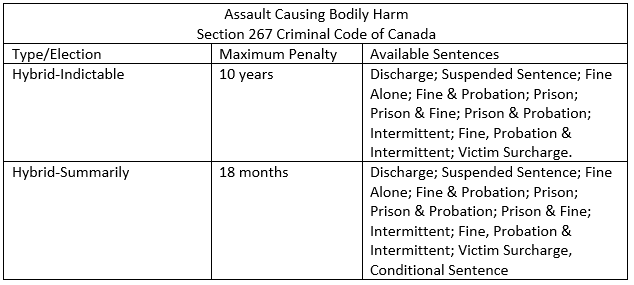
Noting the above, not everyone that is charged with an offence is found guilty. The Crown Attorney has the burden of proving all the elements of the offence beyond a reasonable doubt.
A lawyer may help secure your freedom.
There are several defenses against Assault Causing Bodily Harm offences, most commonly are Defence of Person (Section 34), Defence of Property (Section 35) and Consent (Common Law defence that is limited in application). In addition to exhausting all options of defences found in the Criminal Code of Canada and the Common Law, a Lawyer may also challenge the Crown Attorney’s case. A Lawyer may be able to question the Crown Attorney’s witnesses and statements of the events which may lead the trier of fact, Judge or Jury, to find that the crown has not met their burden of proving every element of the offence beyond a reasonable doubt resulting in a favourable verdict for you.
A lawyer may help secure a lesser sentence.
If one is guilty of an offence, whether by a guilty plea or after a trial, the court is left with the decision on sentencing. The Criminal Code of Canada provides a basic guideline of Maximum and Minimum sentencing permitted and the types of Sentences available for each offence under the Criminal Code of Canada. A lawyer may advocate for a sentence specifically tailored for the individual, which usually means lesser probation, fine, or jail than that sought by the Crown Attorney.
The law is vast and complex. I can help!
REQUEST A FREE CONSULTATION
Fill out the form below to receive a free and confidential initial consultation.