
If you find yourself or a loved one charged with Criminal Harassment, do not take the matter lightly. The elements of Criminal Harassment are found in Section 264 of the Criminal Code of Canada and can lead to significant fines and jail time.
264. (1) No person shall, without lawful authority and knowing that another person is harassed or recklessly as to whether the other person is harassed, engage in conduct referred to in subsection (2) that causes that other person reasonably, in all the circumstances, to fear for their safety or the safety of anyone known to them.
(2) The conduct mentioned in subsection (1) consists of
(a) repeatedly following from place to place the other person or anyone known to them;
(b) repeatedly communicating with, either directly or indirectly, the other person or anyone known to them;
(c) besetting or watching the dwelling-house, or place where the other person, or anyone known to them, resides, works, carries on business or happens to be; or
(d) engaging in threatening conduct directed at the other person or any member of their family.
http://laws-lois.justice.gc.ca/eng/acts/C-46/page-131.html#docCont
Criminal Harassment is a Hybrid Offence. Meaning that where a Defendant is charged with Criminal Harassment, the Crown Attorney can elect to proceed either Summarily or Indictable. The Crown Attorney makes the election, between Summarily and Indictable, early in the proceeding; if the Crown Attorney does not elect, then they are presumed to have elected Indictable. Depending on the election, the accused may face significant incarceration if found guilty.
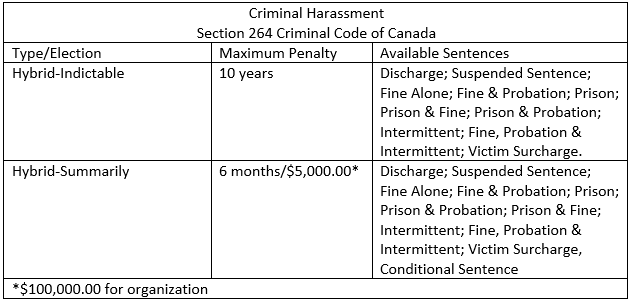
Noting the above, not everyone that is charged with an offence is found guilty. The Crown Attorney has the burden of proving all the elements of the offence beyond a reasonable doubt.
A lawyer can help secure your freedom.
There are several defenses against a Criminal Harassment offence, most commonly are the mens rea of the accused, honest mistake, unreasonable response by the alleged victim etc,. In addition to exhausting all options of defences found in the Criminal Code of Canada and the Common Law, a Lawyer may also challenge the Crown Attorney’s case. A Lawyer may be able to question the Crown Attorney’s witnesses and statements of the events which may lead the trier of fact, Judge or Jury, to find that the crown has not met their burden of proving every element of the offence beyond a reasonable doubt resulting in a favourable verdict for you.
A lawyer can help secure a lesser sentence.
If one is guilty of an offence, whether by a guilty plea or after a trial, the court is left with the decision on sentencing. The Criminal Code of Canada provides a basic guideline of Maximum and Minimum sentencing permitted and the types of Sentences available for each offence under the Criminal Code of Canada. A lawyer may advocate for a sentence specifically tailored for the individual, which usually means lesser probation, fine, or jail than that sought by the Crown Attorney.
The law is vast and complex. I can help!
REQUEST A FREE CONSULTATION
Fill out the form below to receive a free and confidential initial consultation.